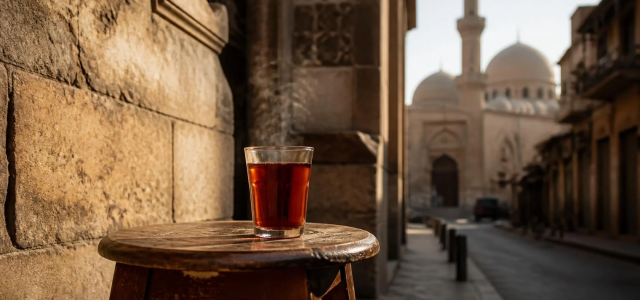
My cousin prayed her first Tahajjud by accident. She’d flown into Cairo that afternoon, slept for four hours, and woke up at 3 a.m. with her brain fully switched on and her body somewhere over the Mediterranean. Nothing open. One cat on the wall across the street, not moving. She told me she stood there in the dark for a minute feeling stupid, then thought, fine, I’m awake, and made wudu. Two rakahs. She cried in the second one and had no idea why.
I asked her what it felt like. “Like I was the only person in the building who knew the secret.” Then she went back to bed and slept till noon.
So that’s Tahajjud, more or less. It’s the prayer you pray after you’ve slept, when nobody is watching and nothing is asking for you.
The word itself
The Arabic root means to get up from sleep, which is why the strict definition says you have to have actually slept first. People use the word for any night prayer, and honestly nobody will correct you at a dinner. But if you want to be exact, sleep comes first, then you wake, then you pray.
The Quran brings it up in Surah Al-Isra, telling the Prophet to pray part of the night as something extra. Extra is the key word. It was never made compulsory for everyone else, so if you’ve been feeling guilty for not doing it, you can put that down. It’s a bonus, not a debt.
Why people go after it
The Prophet, peace be upon him, said the best prayer after the obligatory ones is the prayer in the middle of the night. That one is in Sahih Muslim. There’s another in Bukhari and Muslim, about Allah coming down to the lowest heaven in the last third of the night and asking who is calling so that He may answer, who is asking so that He may give.
Scholars have talked about how to understand that wording for centuries, and I’m not going to settle it in a blog post. What stands out to me is the invitation. Somebody is listening at that hour. Your phone isn’t lighting up, your boss isn’t emailing, and you have nobody to impress.
When, exactly
Between Isha and Fajr, with the last third of the night being the sweet spot. To find it, take the time from Maghrib to Fajr, split it in three, and the final chunk is yours. In a Cairo winter that lands somewhere around 3 to 5 a.m., though I’d let a prayer app do the arithmetic. I tried it by hand once and got it wrong by forty minutes.
And if you really can’t trust yourself to wake up, there’s a hadith saying that whoever fears he won’t get up at the end of the night should pray Witr before he sleeps. So the door isn’t closed on you.
How I’d actually pray it
Two rakahs, then salam. Then two more if you feel like it. That’s the whole structure. The Prophet prayed up to eleven according to Aisha, in Bukhari and Muslim, but there are reports of him praying fewer too, so please don’t set yourself a target of eleven on night one. Two rakahs you really pray are worth more than eight you only plan.
Make wudu, face the qiblah, intend it in your heart, and pray like any other voluntary prayer. Some people take longer surahs here, or stay in sujood for a while, because that’s where dua feels thickest. End with Witr so your last prayer of the night is an odd number.
Then sit. Don’t grab your phone. The sitting is half of it, and I only figured that out after years of skipping it.
If you’re starting from zero
Choose one night. A Thursday, maybe. Set your alarm twenty minutes before you think you need it, and leave a glass of water and your prayer mat next to the bed. It sounds silly, but those two things remove most of the excuses I used to give myself.
Sleep early. Tahajjud is decided by your bedtime far more than your willpower. I’ve watched people try it on five hours of sleep and give up within a week.
If you’re stuck between two big decisions, a lot of people pair this prayer with Istikhara, and our guide to Istikhara walks through how.
Where Arabic comes in
Standing longer means reciting more from memory, and that’s where most people stall. Knowing even a handful of short surahs properly changes the whole prayer. Our Qur’an Intensive program in Cairo is built around memorization with tajweed, and I’ve always felt the night prayer is where memorized verses stop being homework and start being yours.
Conclusion
My cousin still talks about that cat. She’s convinced it was supervising. These days she prays two rakahs on Thursdays, usually yawning, and says it’s the one part of her week nobody else has a claim on. If you’d like to understand the Arabic behind the words you pray, you’re welcome to learn with us at Studio Arabiya.
FAQs
Do I have to sleep before praying Tahajjud? Strictly, yes. The word points to getting up from sleep, so scholars describe it as the night prayer after you’ve slept. Praying voluntary prayers before bed still counts for something, it just has another name.
How many rakahs is Tahajjud? There’s no fixed number. The Prophet prayed up to eleven and sometimes fewer, and two is the least people pray. Go in pairs, finish with Witr, and start small so it turns into a habit you can keep.
What if I can’t wake up in the last third of the night? Pray Witr before you sleep, as the hadith advises, and aim to wake up some of the time. Even catching the last hour before Fajr is worth a lot. Try one early night a week to begin with.